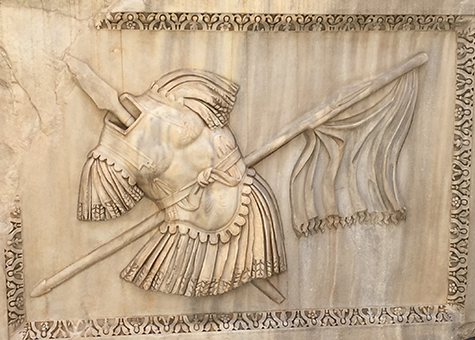
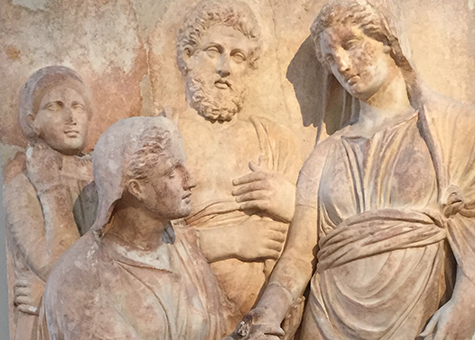
The Department of Classics, Arabic, and Jewish Studies houses a variety of major and minor programs. The Classics program immerses students in the world of ancient Greece and Rome through the study of the languages, histories, cultures, and material remains of the ancient Mediterranean. The Arabic Studies program offers a special focus on Arabic language, literature, and culture. Jewish Studies introduces students to the history, culture and religion of Jewish people, past and present, across the globe
An interdisciplinary program, Classics offers majors three tracks: Classical Languages, Classical Studies, and Classical and Medieval Studies. Students have the flexibility to focus largely on a single area or interweave the concentrations. They are mentored by faculty members who are engaged in original research and publishing actively in their field.
A grounding in Classics begins with reading proficiency—though not necessarily fluency—in one or more languages. Students read works of ancient literature in the original, gaining direct access to Homer, Sappho, Sophocles, Plato, Caesar, Cicero, and Vergil, among other foundational writers. Through their studies, Classics students develop skills in close reading of primary and secondary sources, with an emphasis on comprehension and critical analysis. They ask and answer thought-provoking questions such as why literature develops, how democracies are established and nourished, what is justice, and how is a good life defined and achieved.
The study of classics is the foundation of a liberal arts education and has real-world relevance. By critically examining the distant past students gain a richer understanding of the world around them. Drawing upon their versatile training, Classics majors pursue careers in areas such as law, medicine, education, government, business, advertising, acting and more. Some pursue advanced academic work in Classics, literature, women's studies, religious studies and other disciplines. Classics is truly training for life.